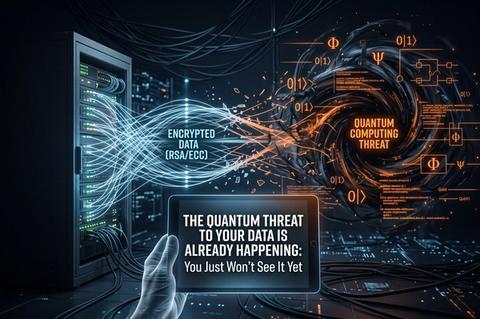
The Quantum Threat to Your Data Is Already Happening: You Just Won’t See It Yet
Here’s the uncomfortable part about quantum computing: an attacker doesn’t need a quantum computer today to put some of your data at risk.
Read more
Fraudsters don’t necessarily need to guess a password. They can use credentials that already work. A system built primarily to flag the wrong password has very little to flag when the password is correct.

Account takeover doesn’t look like a hack anymore. It can look like a real login, from a real device, using a real password. That’s the problem.
Fraudsters don’t necessarily need to guess a password. They can use credentials that already work. A system built primarily to flag the wrong password has very little to flag when the password is correct.
Instead, what is needed is the ability to recognize that the person using the credential may not be the person who owns it. That means looking beyond the credential itself: device, network, transaction behavior, relationships between accounts and other signals that can reveal whether a perfectly valid login is actually inconsistent.
That’s where behavioral authentication and more sophisticated pattern detection come in. And it’s also where quantum computing is beginning to enter the conversation.
Lloyds Banking Group recently completed a nine-month experiment with IBM to explore whether quantum computing could help detect financial crime. The project used anonymized real transaction data and quantum algorithms running on IBM’s cloud-based quantum computers to look for money-mule activity hidden within complex transaction networks.
Cleverly, the team deliberately embedded a mule account in the data to test whether the approach could identify it. And it did!
But the more interesting takeaway isn't that a quantum computer found one fraudulent account. It’s what Lloyds was actually testing.
The experiment focused on graph-based analysis: understanding the relationships between customers, accounts and payments and finding suspicious patterns that may be difficult or expensive to uncover using conventional approaches. Basically, it's a bank testing whether quantum-assisted pattern recognition can catch what today's tools miss. And it matters for account takeover specifically, because the same kind of find the needle in an impossibly large haystack problem applies: is this login, in this network of a million logins, actually the fraudster wearing someone else's credentials?
Lloyds says the goal wasn't to replace its existing machine-learning systems, but to explore whether quantum techniques could eventually generate more sophisticated features to support them. That distinction matters. Quantum isn't replacing the fraud stack. It may eventually become another tool inside it.
Account takeover creates a similar problem. One login, viewed by itself, may look perfectly legitimate. Put that login into a much larger network of activity and the picture can change.
Maybe the device is new. The behavior is unusual. The network connection doesn't fit the customer's history. The transaction pattern looks different. Or the same credential is suddenly behaving like it belongs to someone else.
The challenge is finding that signal without drowning fraud operations in false positives. That is a data problem before it is a quantum problem. And that’s the part I beleive financial institutions should be paying attention to now.
I'm not telling clients to go buy a quantum computer. I'm telling them to look at the foundation underneath the fraud strategy they already have. Can your authentication program distinguish “unusual” from “fraudulent”?
Can your systems connect signals across transactions, devices, accounts and channels?
Can your fraud models use behavioral intelligence without creating so many false positives that your operations team stops trusting the alerts?
If the answer is no, quantum isn't your next problem.
Your foundation is!
The institutions experimenting with quantum today aren't waiting for the technology to become mainstream before thinking about these questions. They're using experimentation to understand where it might eventually provide an advantage, and what their data and architecture need to look like when it does. Lloyds itself describes the experiment as part of building internal capability and a longer-term quantum roadmap. That's the lesson I would take from it.
You don't prepare for the next generation of fraud detection by starting with the technology. You start by making sure the data, authentication and detection architecture underneath it are ready.
And quantum may eventually make that architecture considerably more powerful. Thinking this through, it could also create an entirely different security problem.
Next: quantum computing isn't only a potential tool for fighting account takeover. It could someday make some of today's cryptographic protections vulnerable.
That's the “harvest now, decrypt later” problem and it's already something financial institutions need to be thinking about.
Where does your team stand on behavioral authentication versus rules-based fraud detection? I'd be interested to hear how you're approaching it.
More insights on payments, fintech, and strategic consulting
Here’s the uncomfortable part about quantum computing: an attacker doesn’t need a quantum computer today to put some of your data at risk.
Read more

On August 5, MoneyPass stopped being part of Fiserv and became an independent company. That is a pretty significant change for a network with more than 37,000 surcharge-free ATMs and 160 million cardholders.
Read more

The conversation around retail-acquired card fraud often focuses on the consumer who loses money or the retailer dealing with a frustrated customer. But the financial impact reaches much farther across the ecosystem.
Read more

I’ve spent the last three posts digging into the retail physical gift card issue: physical packaging cannot win an arms race against organized crime syndicates, and any security fix we attempt has to clear the register in the exact same heartbeat as a standard credit card tap. That leaves us with one question: What does a fast, secure, and compliant gift card actually look like in the real world? The answer really seems quite simple: remove sensitive payment credentials from the physical card.
Read more

E&S Consulting delivers data-driven strategies to enhance your decision-making, minimize operational risk, and cultivate the partnerships necessary for long-term success.